
A recent project surfaced on the Mr Cruel subreddit this week that shifts the standard approach to independent cold case research. Titled "Operation Gamut," the creator - with the handle "BozoBozovic" - mapped every Melbourne suburb exposed to historical aircraft noise and cross-referenced the zone with real estate databases. They systematically analysed 368 suburbs and 1,059,927 homes to identify properties matching the physical bathroom layout described by the victims.
The operation did not uncover a definitive smoking gun. And it missed the house of the new suspect I have identified (see Chapter 6 for a comprehensive review of this Thomastown property).
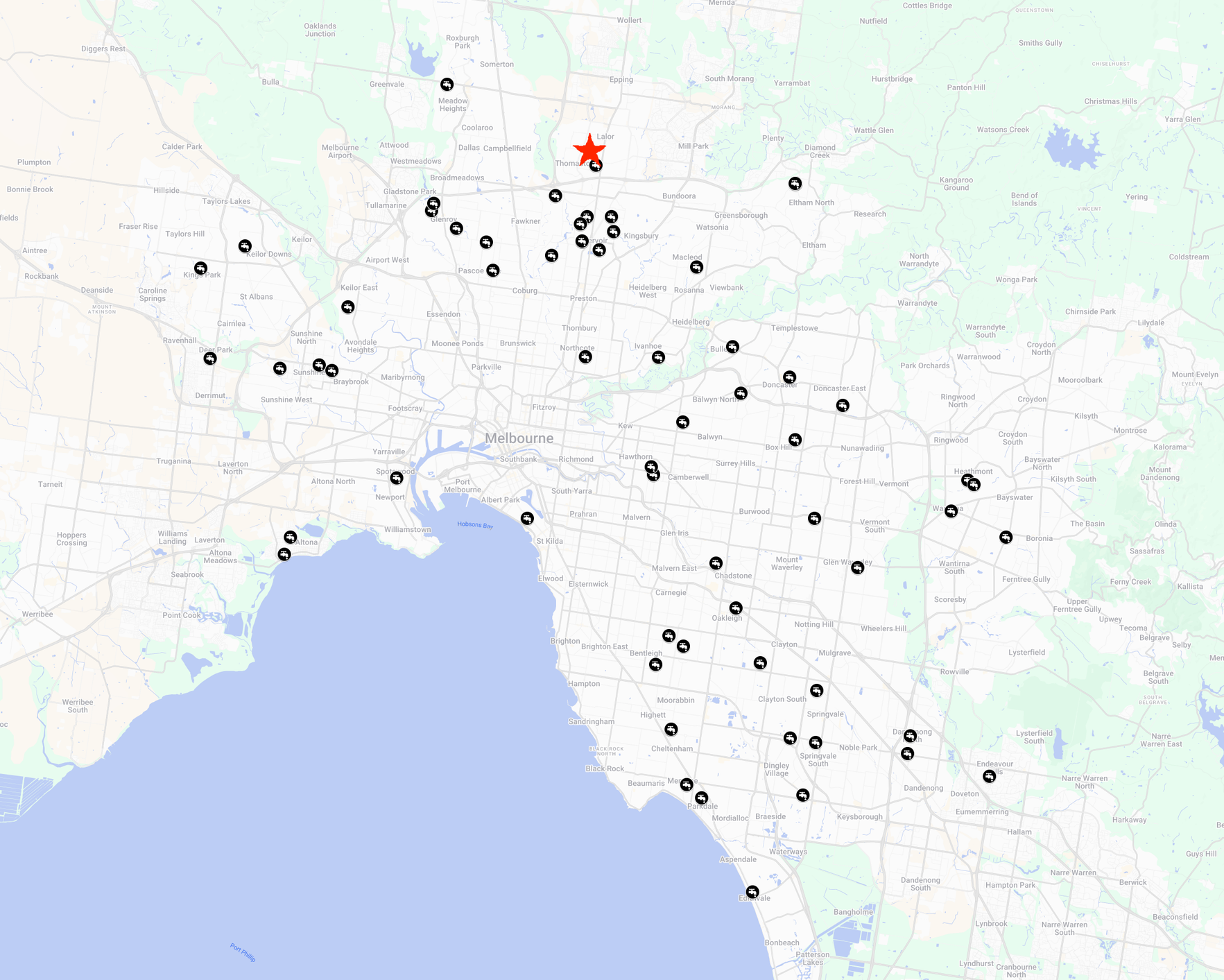
However, as an exercise in open-source synthesis, the effort required to do this deserves recognition. It highlights exactly how difficult it is to find even a single architectural variable that cleanly matches historical descriptions when dealing with a massive metropolitan data set.
The value of the project lies in the realism of its caveats. Or the fact that the researcher even included them. Two particularly noteworthy points were that a vast portion of Melbourne's historical property footprint has been altered. And that the offender could easily have changed the bathroom to make it look different from the sketch.
My research has drawn the same conclusions. The early post-war houses are too small and out-of-date to meet the needs of many families, and the cost to renovate is prohibitive. Financially, it makes more sense to demolish, sub-divide and start over. As such, public real estate photos either reflect post-2000 renovations or total rebuilds.
Given Mr Cruel's forensic awareness and seemingly strong desire to not get caught, it's also reasonable to assume he altered his bathroom once he realised that the police were looking for it. This may have been much earlier than January 1993 when the drawings were splashed all over the news, as there have always been quiet suggestions about Mr Cruel having an insider informer within Victoria Police.
In fact, this offender's long-term behaviour suggests he may have even predicted that the victims would be able to describe his bathroom, and so perhaps he also changed it before he abducted them. This way, no one who knew him and who had visited his house in the past, would connect them together.
Identifying Mr Cruel by finding his house has always been fraught with difficulties. Amongst them is the fact that if you cast a wide-enough net so you don't accidentally miss it, there's a trade-off in depth of analysis.
Interestingly, I didn't suffer from this issue, because I didn't find the offender by finding his house first. In contrast, his house came to my attention because he was already suspicious. It enabled me to run my house research in reverse. My research question was therefore not "Can I find Mr Cruel's house in one of these 20 suburbs?", but "Is this house in Thomastown that matches the victim's descriptions unique in its design in the surrounding area?"
Because I didn't need to cast such a wide net, I could focus instead on the depth of the analysis. I manually analysed thousands of homes across Thomastown, Lalor, Epping, Campbellfield, and Reservoir. I studied the architectural history of the area. I went house-to-house, and I built a database that captured the internal house plans that match to particular external shapes. And then I layered multiple variables on top of each other - driveway position, bedroom window orientation to the Melbourne Airport flight paths, bathroom layout, "kitchen" access to the driveway, and whether there was an explanation for why the victims heard no external noise except the overheard planes.
Out of those thousands of homes, no other property matched the criteria. Or even most of the criteria.
Skeptics will naturally argue that without analysis of every single one of the millions of homes across Melbourne, you cannot definitively claim a property is the unique match. But you don't have to search every property in Melbourne to make that claim, because no one is hinging a criminal conviction and a life sentence in jail on that one factor alone. It is significant that only one house in the northern suburbs appears to match.
Operation Gamut’s sweep adds to this, because it has shown that even when looking at a massive sample size, finding a layout that satisfies even a single variable of the victim's unusual descriptions is extremely difficult. The researcher made a particularly astute comment about seeing "a good number of bathrooms that did not look like the sketch at all but could plausibly have been described that way by a blindfolded or partially blindfolded person. This made me question the accuracy (or at least the precision) of the sketch."
I agree wholeheartedly with this comment. And this is not a criticism of the victims. They observed what they observed. It was the police's job to interpret the possibilities to explain their observations. There are numerous bathrooms in the housing estates in the northern suburbs that appear square-shaped on the floor plans, and even oriented the wrong way to the police sketch. But in real life,they feel narrow and skinny and oriented the correct way once you step inside the room, and turn through the doorway.
As the independent research community is beginning to realise, the truth resides in the gaps and nuances of the case. The foundational framework of my research is a gap-analysis or sorts, and is laid out in Chapters 1-4, which are currently open to access for free.
