
Before abducting 13-year-old Karmein Chan from her Templestowe home in April 1991, the offender spray-painted a message across the side of the family’s vehicle. The text read: "Pay back, Asian drug dealer. More anon. More to come."
Throughout his campaign, Mr Cruel consistently introduced red herrings to misdirect investigators. This particular diversion proved exceptionally effective, causing decades of analytical paralysis. Both the press and the public fixated almost exclusively on the opening accusation. The phrase "Asian drug dealer" fit all too neatly into the localised, racialised crime narratives of the early 1990s, sparking persistent rumours regarding the Chan family that Victoria Police repeatedly, yet unsuccessfully, tried to debunk.
This sensationalised distraction allowed a critical piece of primary evidence in the second sentence to remain hidden in plain sight. Everyone missed the archaic adverb "anon."
The Clerkly Class and the Etymology of "Anon"
Conventional true-crime commentary has long dismissed "anon" as a crude abbreviation for "anonymous". The widely accepted theory is that the offender simply ran out of space or lacked spelling proficiency when signing off his name.
From an investigative perspective, this interpretation defies logic. There is no social convention that directs intruders to formally sign their threats, and interpreting the graffiti in this way as an abbreviation for a covert signature, renders the sentence nonsensical by placing the sign off mid-sentence. It would become "More, Signed Anonymous. More to come." The majority of the media have dealt with this confusing word by simply deleting it from the historical record, frequently transcribing the graffiti as: "Payback, Asian Drug Dealer. More. More to come."
In historical reality, "anon" was utilised with a highly specific, traditional meaning. While originating as a Shakespearean adverb meaning "soon" or "presently," its usage shifted during the late 19th and early 20th centuries. By the mid-1900s, it had become a staple of British English training within the Australian "clerkly class". These are the banking executives, accountants, lawyers, and career public servants who prized procedural efficiency but maintained formal linguistic habits.
Within this specific institutional subculture, the exact phrase "more anon" functioned as standard shorthand for "more details to follow" or "stay tuned for further information." The routine, functional nature of this phrase is captured in archival records of the era, appearing casually even in local print, as seen in a 1949 notice in a Gippsland newspaper:
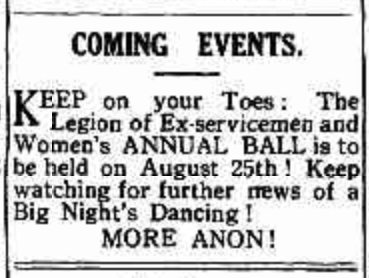
By the time Mr Cruel scrawled it onto the Chan family car in 1991, the phrase had largely faded from the public vernacular, preserved primarily within legacy government internal logs and archived public service documentation. Decoded through its correct historical context, the graffiti transforms from a misspelled de-identified signature into a definitive, mocking statement:
"Payback, Asian Drug Dealer. More about this soon. More to come."
The offender was not hiding his identity, he was boasting. But it was not the first time this linguistic anomaly had appeared in a Victorian homicide investigation.
The December 1988 Correspondence
In October 1988, former Deputy Police Commissioner Paul Delianis authored a prominent feature article re-examining the Tynong North and Frankston serial murders of 1980 and 1981. Two months later, in December 1988, the family of Catherine Headland, the youngest victim of that unsolved series, received an anonymous Christmas card.
Inside, beneath the pre-printed holiday greeting, the author handwrote a calculated taunt. Corrected for its deliberate errors in spelling and grammar, the text read:
"I hope in writing to you, I do not cause you or your family any stress. I can comprehend the pain, the agony you have endured to lose a loved one, Catherine, not knowing when or if the perpetrator will ever be caught. Well, the new year may be a good year for you! Things may unfold, the name of the perpetrator, whose deeds make Truro look like kid stuff!"
The author signed off with: "Anon friend! P.S. I’ll keep in touch some time in the New Year.”
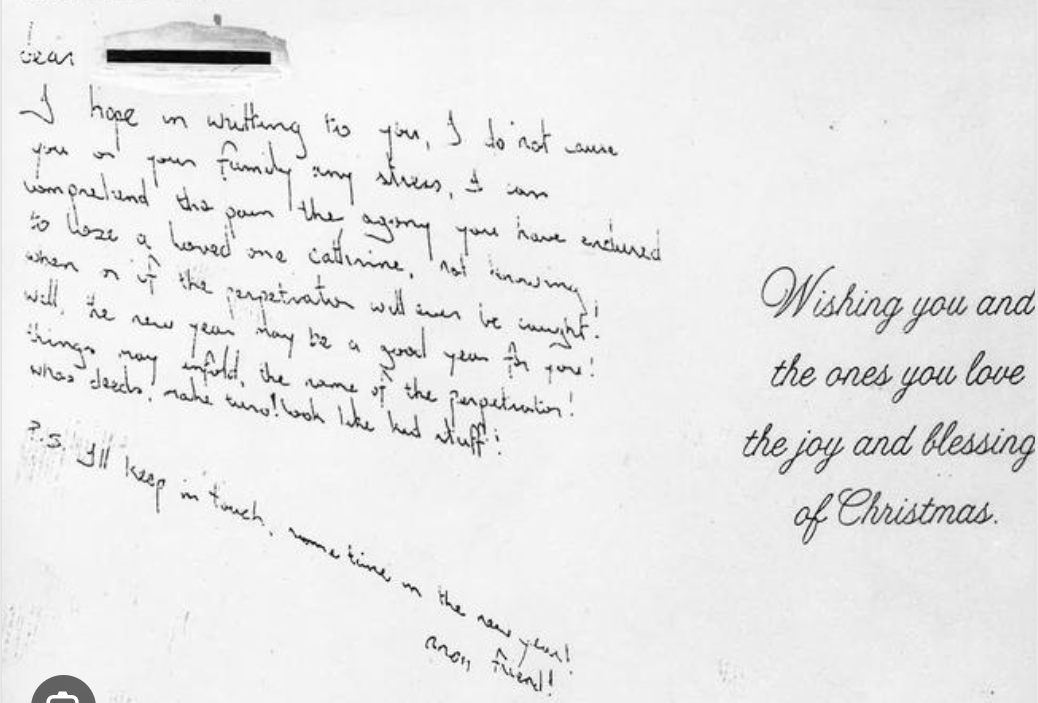
The Head of the Homicide Squad at the time, Detective Chief Inspector Brendon Cole, confirmed that scientific testing indicated the correspondence was entirely genuine. The writer was explicitly comparing his body count to the notorious Truro serial murders - a series of seven sexual homicides prosecuted in South Australia in 1980.
His choice of sign-off, "Anon friend," operated as a deliberate double entendre. While playing on the word "anonymous" to fit the conventions of an unsigned letter, he was simultaneously utilising the archaic adverb in its proper classical context. In traditional theater, characters utilised "anon" as a theatrical way of saying, "I am exiting for now, but I will return shortly." Wielded by an active serial offender, this literary callback is predatory and a direct threat of imminent action: "Your friend, I'll be back soon!"
The Chronological Overlap
When mapped chronologically, the appearance of this highly unusual linguistic signature aligns perfectly with the escalation of the Mr Cruel attacks:
- December 1988: The Headland family receives the Tynong North offender's taunting Christmas card, signed "Anon friend!"
- Boxing Day 1988 (Days later): An unprecedented, highly sophisticated home invasion occurs in Ringwood. A ten-year-old girl is abducted and held captive for 18 hours before being released. This marked the official, public escalation of the Mr Cruel series.
- April 1991: During the abduction of Karmein Chan, the offender uses permanent spray paint to leave the definitive phrase "More anon" at the primary crime scene.
The underlying behavioral structure of these two communications is identical. Both utilise an archaic adverb to mock the police and torment grieving families with the threat of future actions.
More Than Just the Word: The Arrogant Redundancy
When you look closely at this chronological pattern, a fascinating piece of psychological redundancy emerges. The offender didn't just share a unique vocabulary, he shared an identical behavioural quirk.
The author of these words was trapped in a cycle of writing elite, literary riddles, and then immediately providing his own plain-English translations because he believed his pursuers were too blind to understand him.
In the 1988 Christmas card, he threw down the sophisticated Shakespearean double entendre: "Anon friend!" To the writer, this was an active, theatrical promise of proximity: "Your friend - I'll be back soon!" Yet, his ego seemingly couldn't trust the detectives to decode it. Because in the very next line, he added a postscript that repeated the exact same threat using common, modern English: "P.S. I’ll keep in touch some time in the New Year."
Three years later on the side of the Chan family's car, he executed the exact same structural loop. His ego demanded a throwback to the word, but having watched the police fail to decode his 1988 literary sign-off, his ego fractured. He refused to let the riddle go over their heads a second time. This time, formatting it in the rigid, functional style of a clerkly transaction, he spray-painted: "More anon." Right next to it he provided the subtitle, translating his own forensic signature into plain English for a police force he believed was beneath him: "More to come."
These phrases are entirely redundant. In historical and behavioural reality, it was a calculated, arrogant correction. He was bilingual-taunting the police, repeating his message twice, genuinely seeming to believe the old Shakespearean adage of "None are as wise as I." He was demonstrating his intellectual superiority but it was important to him that his audience understood his demonstration.
The shared use of the word "anon" between two unrelated offenders within a two year period (but never again before or after) is suspicious enough. What makes it nearly impossible to accept as random coincidence is the shared arrogant behaviour of the man writing the word on both occasions.
Bureaucratic Tunnel Vision and Outdated Profiles
Throughout the early 1990s, Victoria Police actively publicised peculiarities in Mr Cruel's language, urging the public to listen for a man who used colloquialisms like "Bozo," "worry wart," or "missy." While these words seemed unusual to contemporary detectives looking for a young suspect, they fit perfectly within the vernacular of an older generation. The official police profile eventually settled on an offender aged in his 30s his 50s (often misquoted by the media as 30 to 50 years of age), placing his formative years in the 1930s or 1940s, an era when those terms, and the clerkly use of "anon," were still active.
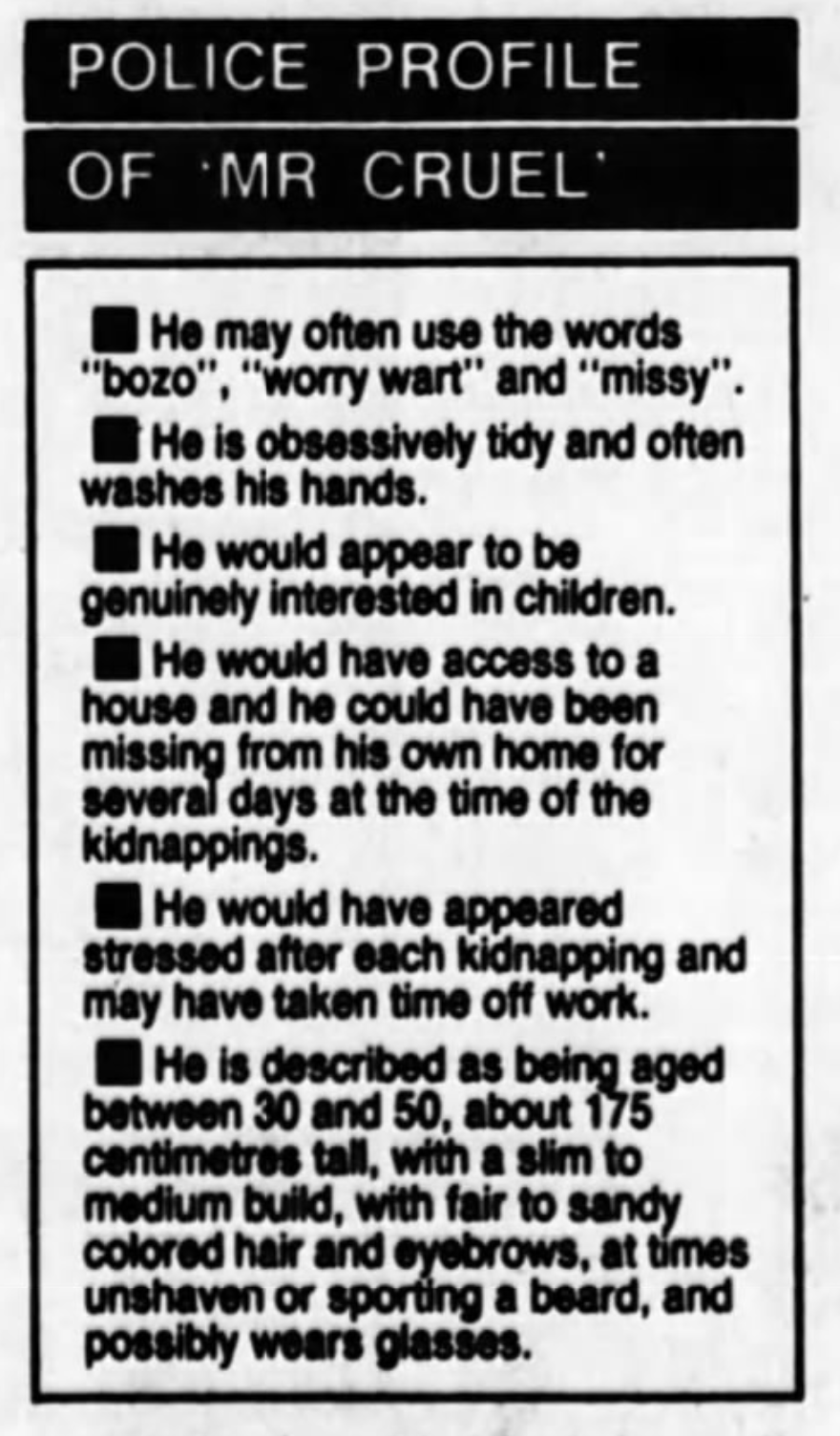
Yet, despite publicising these minor colloquialisms, investigators never drew attention to the word "anon." When the offender left that specific phrase at the Chan crime scene, he was executing a deliberate behavioral link to the unsolved capital murders of the previous decade. He was weaponising an exceptionally rare linguistic habit to mock the state's failure to apprehend him in 1980.
The historical data indicates that Victoria Police were not hunting two unrelated, concurrently operating serial offenders who both happened to possess a rare, identical Shakespearean speech and behavioural pattern.
They were hunting a single, continuous entity whose modus operandi evolved, but whose psychological signature remained entirely fixed.
Enjoyed this chapter? The Disclosure Archive is an independent research project. Sign up for free to receive future chapter releases and updates.
