Within days of Karmein Chan’s abduction, police revealed they were now almost certain that her kidnapper was the same man responsible for the three preceding attacks. They said they were compiling a profile of him, and had uncovered similarities in the methods he used in each assault. The papers reported:
“The abduction victims lived in houses one street off a main road,” detectives said. "The victims had sisters, and the kidnapper freed his victims at night. Both the Ringwood and Canterbury victims were bound and blindfolded while they were held and later released within 5 km of their home.”
Police also noted a concerning escalation, saying the offender’s methods of torture seemed to become more vicious with each attack, although they didn’t elaborate on what that meant.
On the Sunday afternoon following Karmein’s abduction, the 18-hour mark came and went. That was how long the Ringwood victim had been held before she was released.
Then the 50-hour mark, the length of time the Canterbury victim had been held, came and went too.
With no sign of Karmein after 72 hours, police made the decision to have her parents, John and Phyllis, front the media and plead for their daughter’s return.
Pleading for mercy with a psychopath: The cries that broke Melbourne
Unfortunately, John and Phyllis Chan, for whom English was a second language, didn’t have the practised composure and polished British accent of the previous victim’s father. They didn’t have his executive business experience either, or his ability to choose his words strategically while under immense pressure.
Predictably, the press conference did not go the way the police had hoped.
The media had latched onto the red-herring message the offender spray-painted on the family’s car, and they went after the Chans with it. They baselessly suggested the Chans were Asian drug dealers, and therefore somehow responsible for their own daughter’s abduction. John Chan, answering in broken English, sounded defensive, and the media made the most of it. The police tried to counter this racist trope, and have consistently maintained there’s no evidence to support it.
The allegation, remember, was written by a serial sex offender with a can of spray paint, in the middle of kidnapping a child. The author of this graffiti-based allegation and threat is not exactly a reliable source of accurate information.
The police misread this offender and the situation in general, and 35 years on, I suspect they’re still kicking themselves for recommending that press conference go ahead.
At this point, police were still under the impression that this man was capable of some degree of empathy and kindness. He had fed his previous victims lemonade and milk, and treated them gently - while assaulting them. They let this cloud their better judgement, and drown out what they already knew. This was a man who had spent weeks or months planning a violent kidnapping so he could sexually assault a child, which is not usually the work of someone with a soft side.
And so the distraught and exhausted Chans sat in the glare of the television cameras, in front of journalists who were hostile or, at the very least, unsympathetic, begging for mercy from a violent man with no empathy at all, who was somewhere out there with their 13-year-old daughter.
Phyllis Chan broke down, sobbing as she held up Karmein’s favourite dress. Between wails, she pleaded for her daughter to be allowed to come home, and for the kidnapper not to ruin her family.
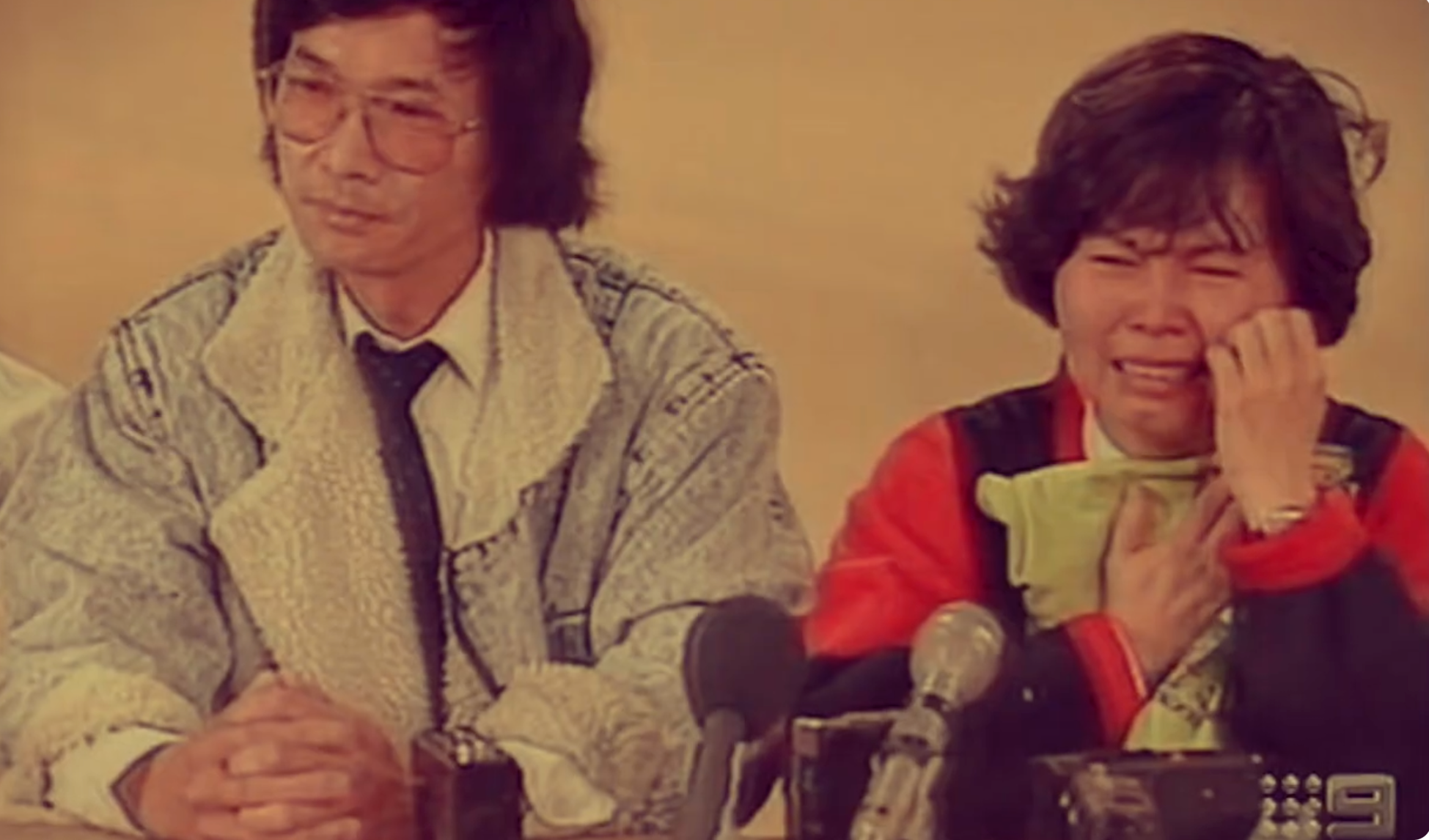
Nobody in Melbourne who saw it has ever forgotten it.
As a city's hope fades, police don't give up
As time passed, the manhunt continued with an intensity Melbourne had never seen before, but after three weeks, detectives publicly admitted they were more likely investigating a murder than a kidnapping.
The lead detective said: “After three weeks you’ve got to say it’s not looking good. In the past he has let them go but this one has gone on too long. It has been three weeks and there hasn’t been any contact. I would say this bloke not only has a good knowledge of forensic science but also of autopsy which means we’ll probably never find her.”
Victoria Police established a dedicated taskforce, Operation Spectrum, to focus exclusively on catching Mr Cruel. They increased the reward to $300,000 for information leading to his arrest.
Roadblocks were set up in places where Karmein had likely been watched before the attack, like her school bus stop. And because Karmein attended the same prestigious girls’ school as the Canterbury victim, police heavily investigated a school connection, scrutinising every teacher and anyone else who might have had contact with the girls. When that found no link, they started entertaining the idea that Mr Cruel had targeted two victims in a row from the same school merely as a massive diversionary tactic.
Police distributed millions of leaflets across the state and into border towns in New South Wales and South Australia. They featured the victims’ photos, the places they were taken from, and the dates of the attacks. Police also rented one hundred advertising billboards.
In 1991, it was nearly impossible to walk or drive anywhere in Melbourne without seeing the photos of the three abducted girls, and being confronted by three very blunt questions about the man who took them:
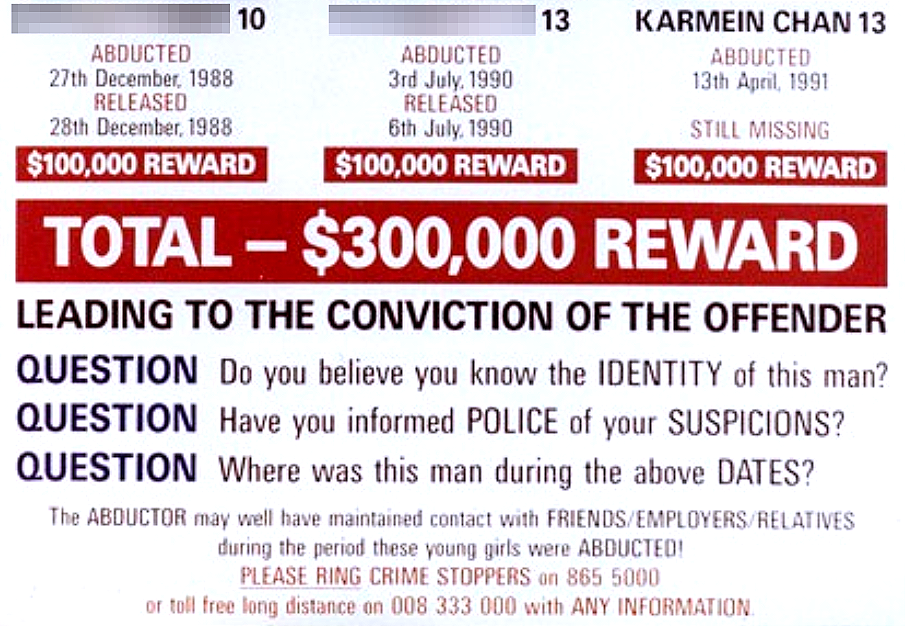
Police followed many leads. None led them to Karmein.
The Chans desperately tried to engage with their daughter's kidnapper.
However much time passed, the Chans refused to believe Karmein might not come home.
In a desperate bid for contact, they convinced a Melbourne newspaper to print a letter addressed directly to Mr Cruel, without police approval or involvement. Believing he was afraid to deal with officials, they urged him to contact them directly, without fear of retribution.
Embedded in the letter was a code they said only Karmein could decipher, which led to a private postal box where he could write to them in strict confidence.
But the postal box never received any mail.
Phyllis Chan would later write another open letter to Mr Cruel, begging for her daughter’s release and offering her own life in exchange.
She wrote: “Karmein’s sisters miss her very, very much. They had trusted you on the night of 13 April. They had cooperated with you because you were calm and you looked kind. You had promised them that after you had gone, their sister would open the door for them. You have broken your promise.”
As the days turned into weeks, Karmein stayed at the forefront of the public mind. The media helped police keep attention on the case, and Melburnians remained gripped by fear of a man who had taken away one of the most basic assumptions of suburban family life, that children were safe from intruders in their own homes.
Detectives reveal new, unique features about the offender
Four months into the investigation, police gave a significant update, and for the first time in years they spoke openly about Mr Cruel’s likely long history of offending. Detective Inspector David Sprague, head of the Spectrum Taskforce, said they had found similarities across nine different attacks dating back to 1985, with victims ranging in age from 10 to 30.
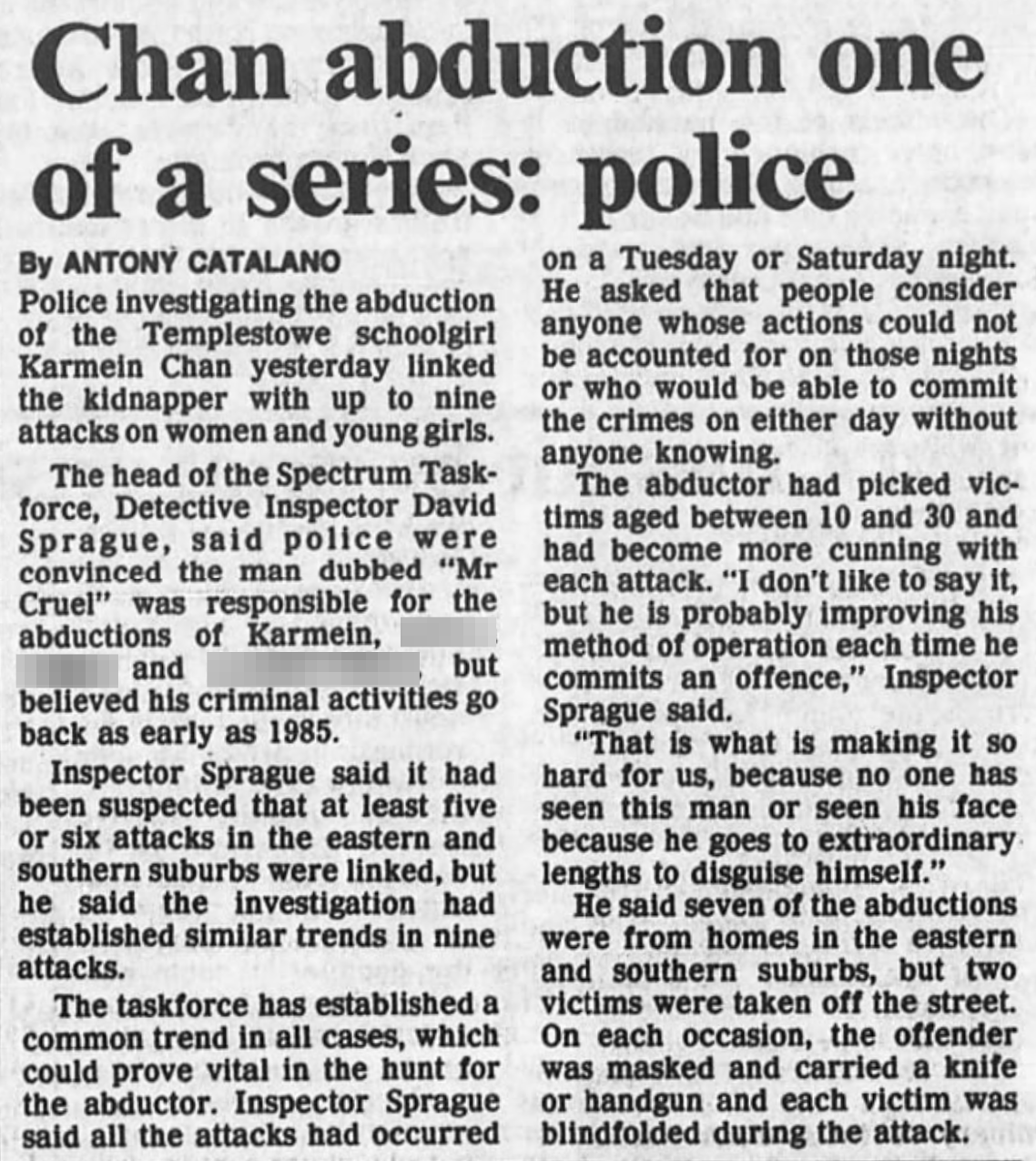
The public, or at least those who had been paying attention, already knew about the attacks in the north-eastern suburbs, but Sprague added details that had never been mentioned before. Some of the nine attacks had happened in Melbourne’s southern suburbs, and two of them had involved victims being kidnapped off the street. For some reason, most of the newspaper reports that followed failed to mention either of these two significant new pieces of information.
Sprague also revealed a feature common to every one of the attacks. They had all taken place on either a Tuesday or a Saturday night.
He urged the public to think about whether they knew anyone who fitted the description of Mr Cruel, whose movements couldn’t be accounted for on those nights, or who was in a position to be out on both nights of the week without anyone noticing. It’s worth thinking about how many men in 1991 could actually do that, again and again over six years, without a wife, a boss or a housemate ever asking where they’d been.
April 1992: Karmein has been missing for nearly one year
The following year, just days before the anniversary of Karmein’s abduction, a man walking his dog near Edgar’s Creek in Thomastown, in Melbourne’s north, came across a bone. On closer inspection he found several more, and was certain they weren’t the remains of any wildlife.
Thomastown was home to a massive piece of built infrastructure, a high-voltage electricity terminal station and a substation, with three high-voltage transmission lines feeding into it. One of those lines originated at the Templestowe substation near the Chans’ home and, before that, ran directly behind the Ringwood victim’s house. And it was right there, where all that copper and steel came together, that the bones were found.
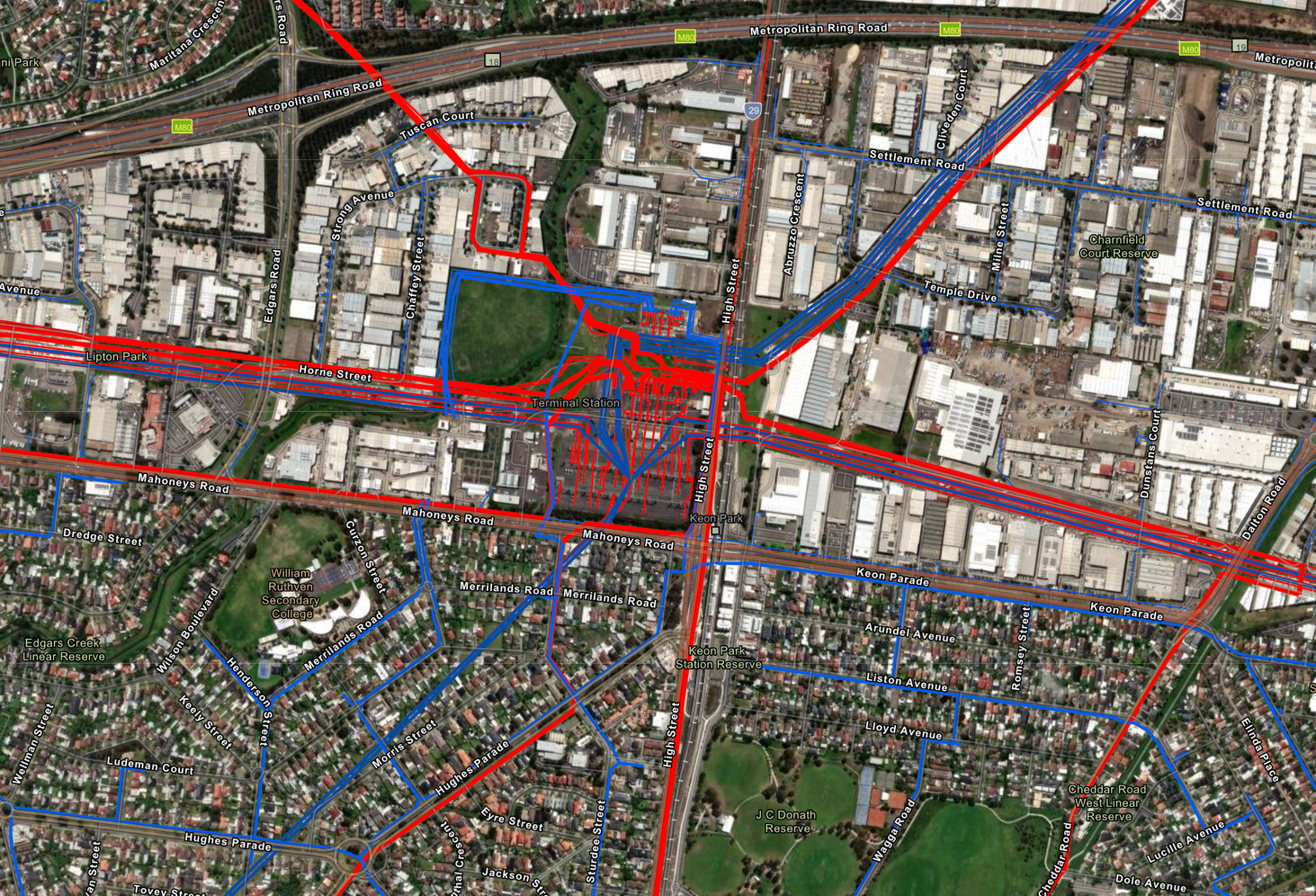
The burial site was not easy to get to. Cyclone fencing blocked it off from the main roads and footpaths on two sides, but it was open at the back, in between some unsavoury factories and warehouses. Few people chose to venture in there.
Today, many sections of the creek are well maintained, and the parkland beside them has formal walking tracks. But not this section. And back in 1991, it was really only popular with people illegally dumping cars or rubbish, or looking for somewhere to ride a motorbike or a horse.
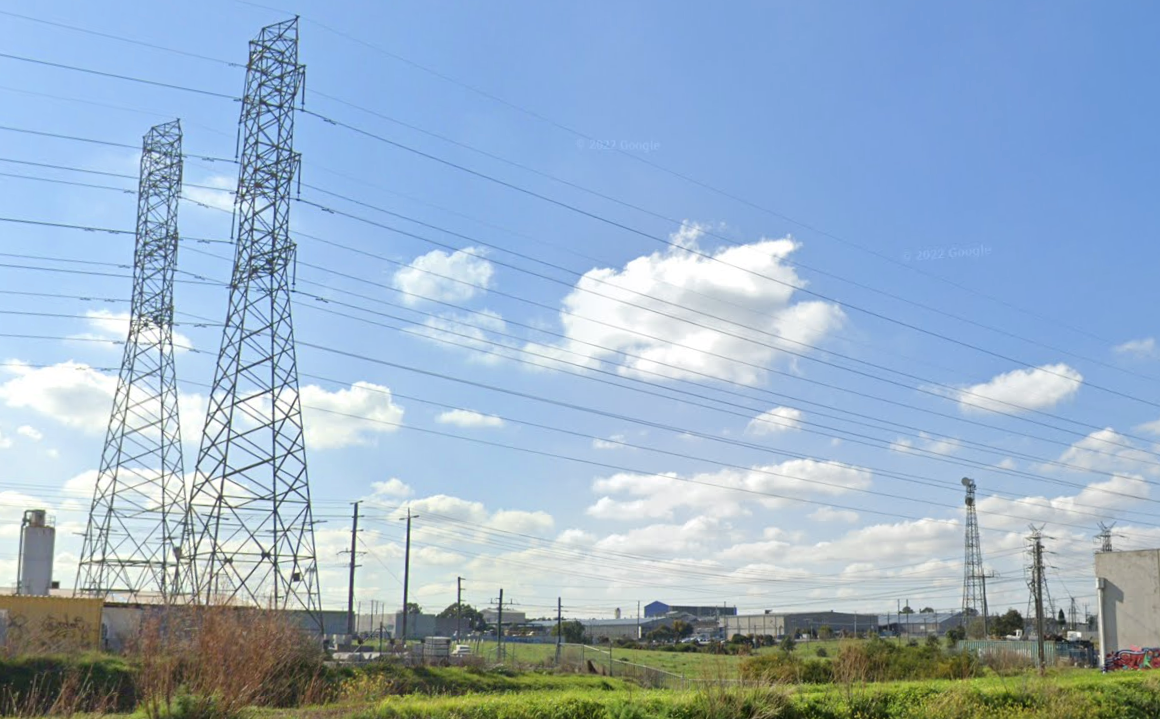
Alternatively, the offender may have walked in along the creek, behind the houses that backed onto the reserve.
Either way, it’s one of those places you would never know about unless you worked or lived in that specific block.
Police quickly found more bones at the scene, though no clothing was recovered. Within days, they confirmed the skeletal remains belonged to 13-year-old Karmein Chan. There were three bullet holes in the side of her skull, which various sources attributed to either a .22 or a .38-calibre gun.
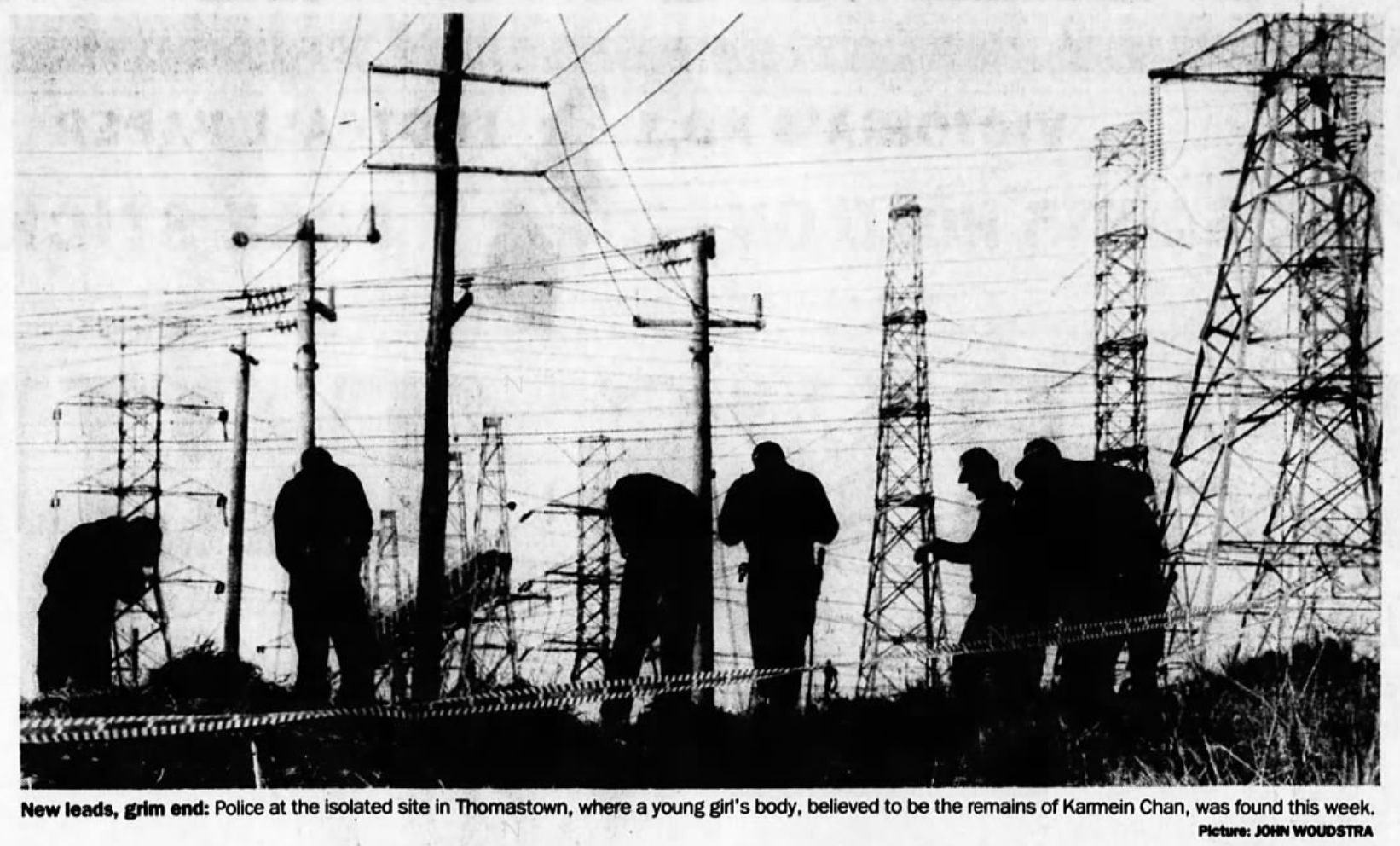
Forensic analysis concluded she had been killed very soon after her abduction, possibly on the same night. The formal cause of death was recorded as gunshot wounds to the head. But with the soft tissue long decomposed, there was no way to rule out another cause, such as strangulation, with the gunshots inflicted after death.
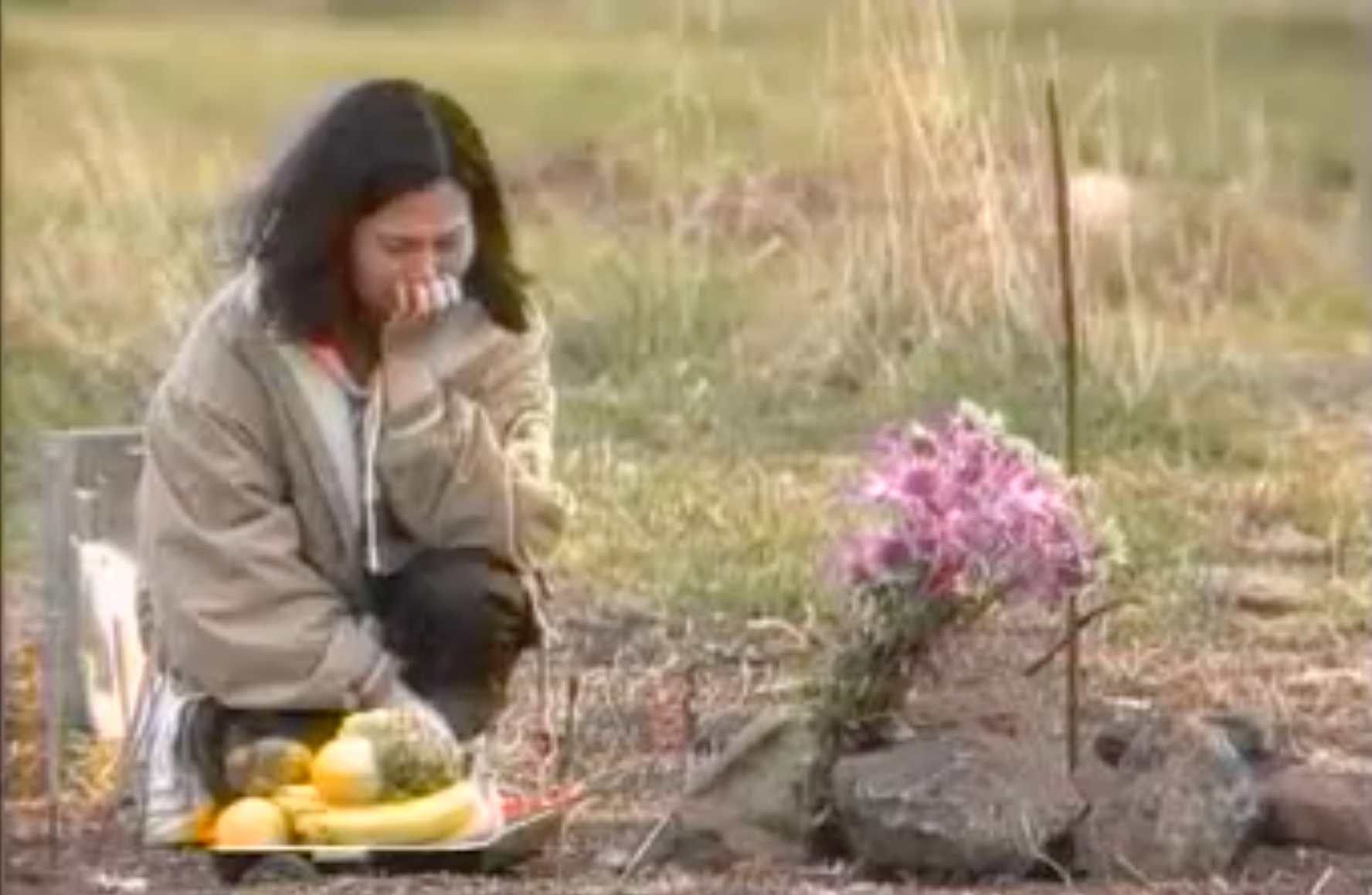
Five weeks later, on Saturday 16 May 1992, Karmein Chan was laid to rest by her parents and friends, in a much more peaceful and deserving place.